Chicken Sh!t/Sole CHICKENSOLE.COM
Griffix Publishing · Press Kit

Press & Media
Chicken Sh!t for the Sole — Discipline for Athletes

An anti-self-help discipline book for athletes ages 15–24 — hard on excuses, never on the athlete. One-line hook · Free to quote verbatim

01

The Book at a Glance

Copy freely · No permission needed
Title Chicken Sh!t for the Sole
Subtitle Discipline for Athletes
Author Fritz Griffin (pen name)
Publisher Griffix Publishing
Publication date June 15, 2026 (First Edition)
Format Paperback & ebook
Trim / pages 6 × 9 in · 180 pp · B&W interior
Paperback ISBN 979-8-9963777-1-8
Ebook ISBN 979-8-9963777-0-1
Price $14.99 paperback · $7.99 Kindle
Audience Athletes & competitors, ages 15–24
Availability Amazon · IngramSpark (bookstores & libraries can order)
Website chickensole.com
Also styled as Chicken Shit for the Sole
02

Press Release

Full text · Indexed & downloadable
↓ Download Release (PDF)
For Immediate Release

The Anti-Chicken Soup: New Book Tells Young Athletes Nobody Is Coming to Save Them

Chicken Sh!t for the Sole: Discipline for Athletes argues that comfort literature has been feeding a generation the wrong meal

San Diego, California — September 1, 2026 — Griffix Publishing today announced the release of Chicken Sh!t for the Sole: Discipline for Athletes by Fritz Griffin, a blunt, coach-voiced discipline guide written for competitors ages 15–24.

The title is a shot across the bow at three decades of inspirational publishing. Griffin's argument is direct: the comfort genre is emotional junk food — it goes down easy and leaves nothing behind.

"Read enough of those stories and you notice something," Griffin said. "Nobody trains. Nobody grinds. Things just work out. A stranger appears. The timing is perfect. The universe delivers. That's a nice thing to read on a bad night, but it's not a plan, and it doesn't build anything."

Agency Versus Chance

The distinction Griffin draws is between two competing stories about how outcomes happen. The comfort genre teaches a passive story where rescue arrives from outside. This book teaches an active one where the athlete builds the outcome.

"The old model taught you to wait — for the right moment, the right break, the right person to show up," Griffin said. "This one teaches you to build. One is hope. The other is evidence. Only one of them shows up on the scoreboard."

The Jurisdiction Problem

Griffin's sharper critique concerns what mindset books claim authority over. Inspirational literature has long applied attitude and perseverance to problems attitude cannot solve — like a layoff or a medical bill. The result is a book that comforts the reader and simultaneously relocates the blame onto him. Nobody organizes. Nobody bargains. You just read another story about someone who kept believing.

Chicken Sh!t for the Sole stakes a narrower claim, and Griffin argues that narrowness is the point.

"Sport is one of the rare places where the causal chain actually holds," Griffin said. "You control your reps. Your sleep. Your film study. Your reset after a bad play. The scoreboard is not a metaphor for the economy — it's just a scoreboard, and it responds to work. That's why this book can make demands a general-purpose self-help book has no business making."

Attack the Excuse. Defend the Athlete.

The book operates under a single governing rule: it is hard on excuses and never cruel to the reader. Griffin draws a firm line between the excuse an athlete practices and the athlete himself — and between manufactured obstacles and real ones. Injury, anxiety, depression, illness, and legitimate hardship are treated as real, not as failures of will.

Across seventeen chapters organized as Watch the Film, Training Camp, Game Day, Your Team and Your Standards, and Keep Walking, the book builds a working vocabulary for competitors:

A closing toolkit includes a 30-Day Discipline Plan, The Rules, an Athlete Nutrition Guide, and printable reset tools available at chickensole.com.

Built From the Sideline, Not the Podium

The book draws on the voices of former professional athletes and coaches who have competed and worked at the highest levels of their sports, and who now bring that experience directly to young competitors. More than a dozen are credited in the acknowledgments.

The final section, Keep Walking, addresses what almost no athlete is prepared for: the day the sport ends. "The game ends," Griffin writes. "The walk does not."

AVAILABILITY
Chicken Sh!t for the Sole: Discipline for Athletes by Fritz Griffin
Griffix Publishing · 180 pages · 6×9 paperback and ebook
Available now on Amazon and through IngramSpark distribution
www.chickensole.com

MEDIA CONTACT
Griffix Publishing · media@chickensole.com
Review copies, written Q&A, and excerpt permissions available on request.
###
03

Cover & Image Assets

Direct links · No forms, no gates
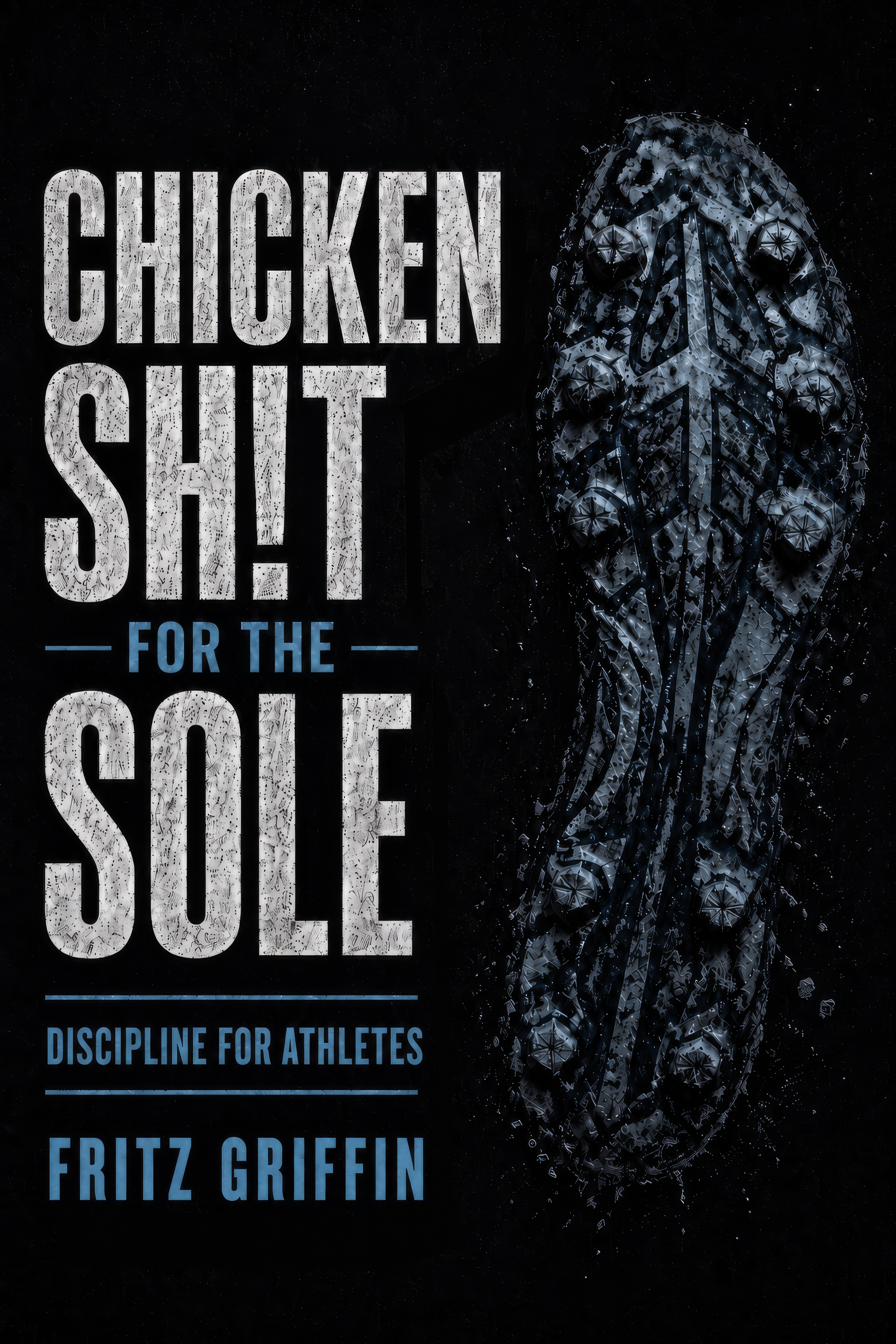
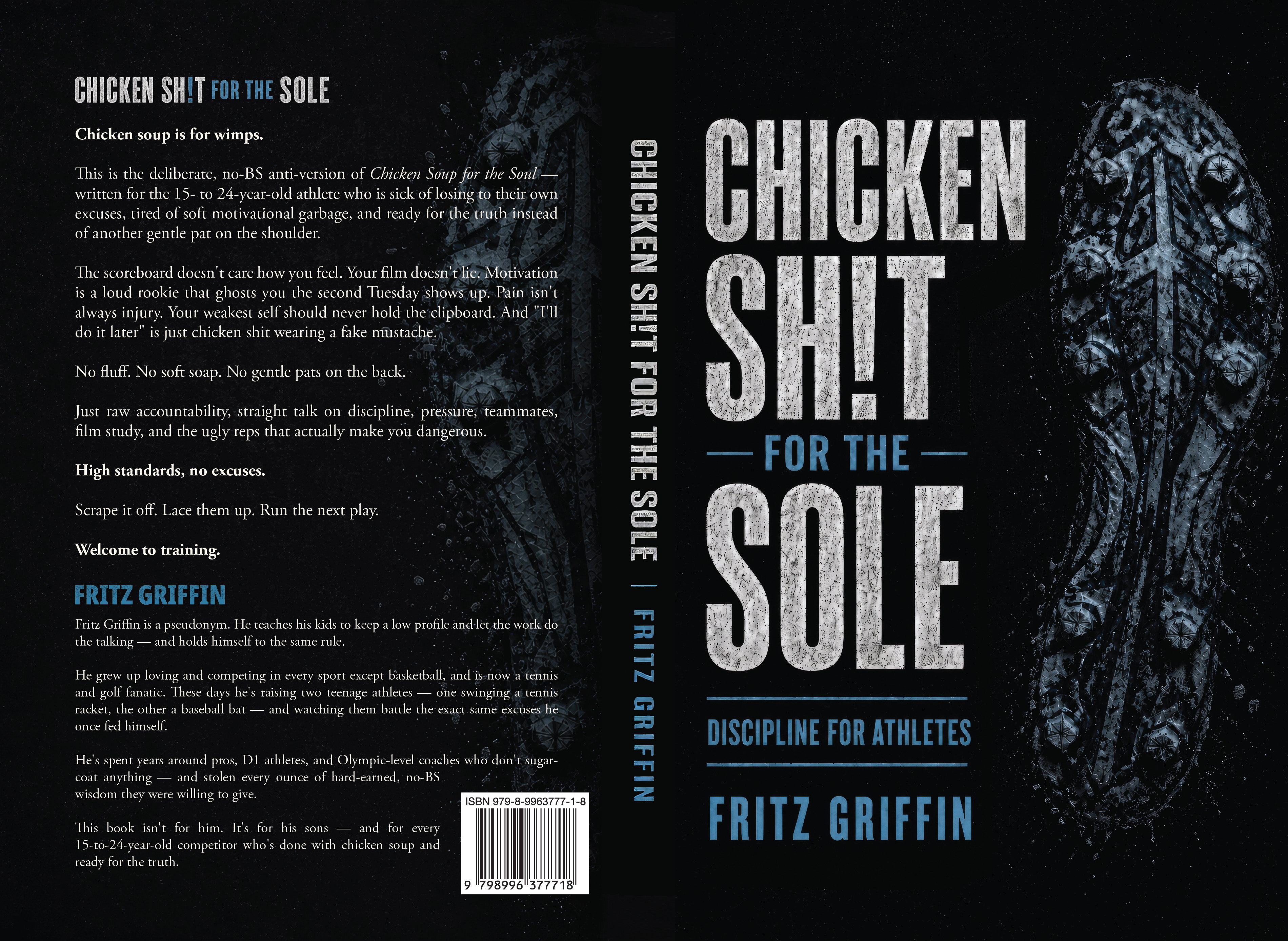
Chicken Sh!t for the Sole — front cover: distressed white and steel-blue type over a black background with a cleat-sole print

Assets may be used for editorial coverage of the book without further permission. Please credit the cover to Griffix Publishing. Do not crop, recolor, or overlay the cover art. Need a format you don't see here? Email media@chickensole.com.

04

Book Description

Quotable · ~150 words

Chicken Sh!t for the Sole is not a book of comforting stories. It is a training manual for the part of an athlete that makes decisions at 6 a.m.

Written in a blunt, coach-voiced style for competitors ages 15–24, the book runs on one rule: attack the excuse, defend the athlete. It is hard on the excuses athletes practice — and it never confuses those excuses with real injury, real anxiety, or real hardship, which it treats with respect.

Across five parts — Watch the Film, Training Camp, Game Day, Your Team and Your Standards, and Keep Walking — Fritz Griffin builds a working vocabulary for discipline, pressure, confidence, and the reset that follows every bad play. The book closes with a 30-Day Discipline Plan, an athlete nutrition guide, and printable reset tools, plus the chapter almost no sports book writes: what to do the day the sport ends.

05

About the Author

Pen name · Stated plainly

Fritz Griffin is a pen name. That's a choice, not a hedge — the author's position is that the work should stand on its own reps, not on a bio.

Griffin writes from years inside competitive youth and elite athletics — seasons, sidelines, training rooms, and the long drives home after bad games. The book draws on the voices of former professional athletes and coaches who have competed and worked at the highest levels of their sports, and it is written for the athlete those coaches see every day: talented, capable, and one practiced excuse away from wasting both.

Griffin's mission fits in one line: attack the excuse, defend the athlete. Interviews are conducted as written Q&A through Griffix Publishing.

06

Suggested Interview Angles

Ready hooks · Take one and run
Angle 01

The Anti-Chicken Soup

Three decades of inspirational publishing sold comfort as fuel. This book calls that emotional junk food — stories where nobody trains, nobody grinds, and things just work out — and offers the opposite meal.

Angle 02

Agency vs. Chance

Why a discipline book for athletes can make demands a general self-help book can't: sport is one of the rare domains where the causal chain holds. Your reps, your sleep, your reset — the scoreboard responds to work.

Angle 03

Hard on Excuses, Never on the Kid

The book's governing rule — attack the excuse, defend the athlete — and where it draws the line: real injury, anxiety, and hardship are treated as real, never mocked, never waved off as weakness.

Angle 04

The Day the Sport Ends

Almost every athletic career ends before age 25, and almost no sports book prepares athletes for it. The final section argues the discipline outlives the game: the game ends, the walk does not.

07

Sample Q&A

Usable as a written interview

Why this title?

Because the shelf it's aimed at earned it. The comfort genre told a generation that believing hard enough was a plan. Athletes know better — a cleat learns more from the ground than a soul learns from soup. The title is a joke with a spine: it tells you in five words that this is not that kind of book.

Isn't "no excuses" just tough-guy cruelty repackaged?

Not in this book, and the distinction is the whole architecture. The rule is attack the excuse, defend the athlete. An excuse is something you practice. An injury, a diagnosis, a real hardship — those aren't excuses, and the book says so in plain terms. Being hard on the excuse is a form of respect. It assumes the athlete can carry the truth.

What's wrong with motivation?

Nothing — for a day. Motivation is a rookie: loud, exciting, gone by Thursday. Discipline is the veteran who shows up when the weather's bad and nobody's filming. The book teaches athletes to stop waiting to feel like it, because the feeling was never the fuel. The schedule is.

You write that confidence is earned. Earned how?

Through evidence. Confidence isn't a mood you talk yourself into before the game — it's the receipt for work already done. The result is the receipt; the process is the purchase. An athlete who has the reps banked doesn't need a pep talk. An athlete who doesn't can't be saved by one.

What do you tell an athlete after a bad play — or a bad season?

Learn it. Flush it. Next play. Watch the film honestly, take the one lesson, and then let it go — because carrying the last play into the next one is how one mistake becomes three. The reset is a skill, and the book treats it like one: something you train, not something you hope for.

Most athletic careers end young. What then?

That's the section I'd defend hardest. The sport ends for everyone — the discipline doesn't have to. The habits an athlete builds are transferable equipment: the reset, the standards, the ability to do hard things on schedule. The game ends. The walk does not. If a reader takes one thing from the book, I'd pick that.

08

Media Contact

Written Q&A available

media@chickensole.com

Griffix Publishing handles all press for Chicken Sh!t for the Sole. The author works under a pen name and conducts interviews as written Q&A — questions in, considered answers out, fully quotable.

Available: review copies · written interviews · excerpt permissions · guest essays
Typical response: within 2 business days
09

Press & Reviews

Updated as coverage lands
!

This section is empty on purpose. The book launched June 15, 2026, and review copies are in the field. Coverage gets posted here as it lands — nothing manufactured, nothing borrowed.

Around here, that's the whole point: the receipt comes after the work. Want to be the first line on this page? Request a review copy.